

Imagine you have a $1,000 sports betting bankroll. You spot a massive value bet in a weekend Premier League match. The odds look great, and your research shows a strong edge.
Now comes the hardest question in gambling: How much do you actually bet?
If you bet $10 (1%), you are leaving money on the table. If you bet $500 (50%), a single bad referee decision could wipe out half your net worth. Most punters guess their bet size based on “gut feeling,” which is exactly why sportsbooks make billions every year.
Professional bettors don’t guess. They use a mathematical formula called the Kelly Criterion to calculate the exact dollar amount that will maximize long-term profit while mathematically preventing bankruptcy.
Table of Contents
The Mathematics Behind the Kelly Criterion
You don’t need a math degree to use this system. You just need to plug four simple numbers into your calculator. The goal is to find your optimal bet size as a percentage of your total bankroll.
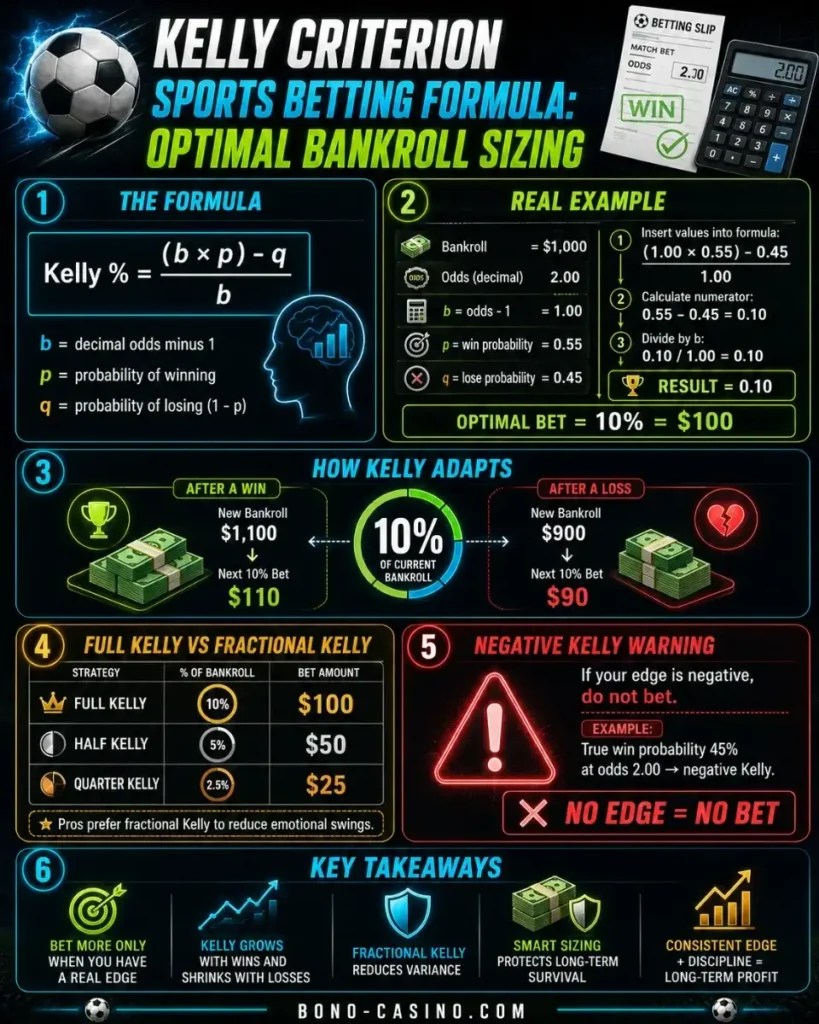
The Formula: f = [ (b * p) – q ] / b
- f: The fraction (percentage) of your current bankroll you should wager.
- b: The decimal odds minus 1. (If the bookmaker offers odds of 2.00, your ‘b’ is 1.00. If the odds are 1.85, your ‘b’ is 0.85).
- p: Your true probability of winning the bet. (If you calculate a 55% chance of winning, ‘p’ is 0.55).
- q: Your probability of losing. (Simply 1 minus p, so 0.45).
Step-by-Step Calculation: Seeing the Money in Action
Let’s put your $1,000 bankroll to work.
You find a bet at Even money (Decimal Odds 2.00). The bookmaker implies a 50% chance of winning. However, your deep-dive analysis proves the team actually has a 55% chance of winning. You have a 5% mathematical edge over the house.
Let’s plug your numbers into the formula:
- b = 1.00 (Odds 2.00 – 1)
- p = 0.55
- q = 0.45
Calculation: [ (1.00 * 0.55) – 0.45 ] / 1.00 = 0.10
The formula tells you to bet exactly 10% of your bankroll. In this scenario, your mathematically optimal bet size is $100.
The Snowball Effect: Flat Betting vs. Kelly Criterion
If you flat bet a fixed $100 every time, your bankroll grows in a slow, straight line. The Kelly Criterion, however, dynamically scales with your success and protects you during failure.
- When you win: Your bankroll grows to $1,100. Your next 10% bet increases to $110. You compound your profits exponentially, much like earning compound interest in the stock market.
- When you lose: Your bankroll drops to $900. Your next 10% bet automatically shrinks to $90.
By shrinking your bet size during a losing streak, the Kelly formula acts as an automatic emergency brake.
The Reality Check: Why “Full Kelly” Will Break Your Heart
Here is the brutal truth: betting 10% of your bankroll on a single match is terrifying.
Sports betting variance is vicious. A 55% win rate means you will still lose 45 out of 100 bets. If you hit a 5-game losing streak betting “Full Kelly” (the exact number the formula gives you), your $1,000 bankroll will violently crash down to around $590 in one weekend. Human psychology cannot handle that level of tilt. Players panic, abandon the math, and start chasing losses.
To survive the mental swings and inevitable bad beats, professional syndicates and sharp bettors use a fraction of the formula.
| Betting Strategy | Bankroll Risk | Profit Potential | Best Used For |
| Flat Betting (Fixed Amount) | Low | Low (Linear) | High-variance casino games, Beginners |
| Full Kelly (100% of Formula) | Very High | Extreme (Exponential) | Theoretical models with 100% accuracy |
| Half Kelly (50% of Formula) | Moderate | High | Aggressive pros with proven track records |
| Quarter Kelly (25% of Formula) | Low-Moderate | Steady & Stable | Serious bettors building a 100 Buy-in bankroll |
If Full Kelly suggests a 10% bet ($100), a Quarter Kelly approach tells you to bet just 2.5% ($25). This perfectly aligns with professional bankroll management, smoothing out the rollercoaster of variance while still guaranteeing long-term growth.
How to Estimate Your True Winning Probability (The ‘p’ Value)
The Kelly Criterion is flawless on paper, but it has one massive vulnerability: Garbage In, Garbage Out.
The formula relies entirely on how accurately you can estimate the ‘p’ (Probability of winning). If you just guess this number based on your favorite team, the formula will destroy your bankroll. Professional bettors calculate ‘p’ by:
- Tracking Closing Line Value (CLV): Comparing the odds they took against the final odds right before the match starts. If you consistently beat the closing line, you have a verified edge.
- Building Statistical Models: Using expected goals (xG), historical performance data, and injury reports to create their own odds, independent of the bookmaker.
- Specializing in Niche Markets: Finding edges in lower-tier leagues or specific prop bets where bookmakers lack deep data.
The Deadly Trap: Betting with a Negative Edge
What happens if you calculate your win chance is 55%, but your model is flawed and the true probability is only 45%?
If you plug a 45% win rate (p = 0.45) into a 2.00 odds bet, the formula gives you a negative number (-0.10).
A negative Kelly result is the mathematics screaming at you: Do not place this bet. The house has the Expected Value (EV) advantage. The Kelly Criterion cannot magically make you a winning bettor. You still need the skill to find value odds. But once you find that edge, Kelly ensures you squeeze every possible dollar out of the bookmaker without risking your financial survival.
Responsible Gambling
No mathematical formula can completely eliminate the inherent risks of sports betting. The Kelly Criterion is a tool for managing risk, not a guarantee of profit. Never wager money you cannot afford to lose, avoid chasing losses, and set strict deposit limits. If you feel you are losing control of your betting habits, please seek professional help immediately through local gambling support organizations.
For a complete library of professional casino reviews, mathematical betting models, and advanced strategy guides, visit our main hub at Bono Casino: The Ultimate Information Hub for Bettors.
